Ascot

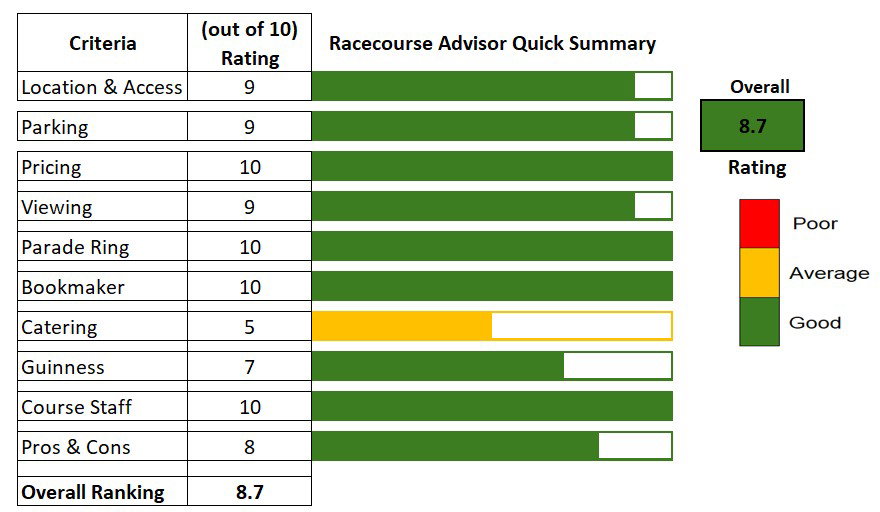
Date of Review: 10th July 2026
RCA Reviewers: Dave & Ray
Address: High St, Ascot SL5 7JX
Website: https://www.ascot.com/
Facebook: https://www.facebook.com/AscotRacecourse/
Email: enquiries@ascot.com
Phone: 0344 346 3000
Accommodation: https://www.trivago.co.uk/en-GB/opr/hotels-near-ascot-racecourse?search=500-1573185
Course Information: There are effectively three courses at Ascot. The Straight Course. The Round Course and the National Hunt Course.
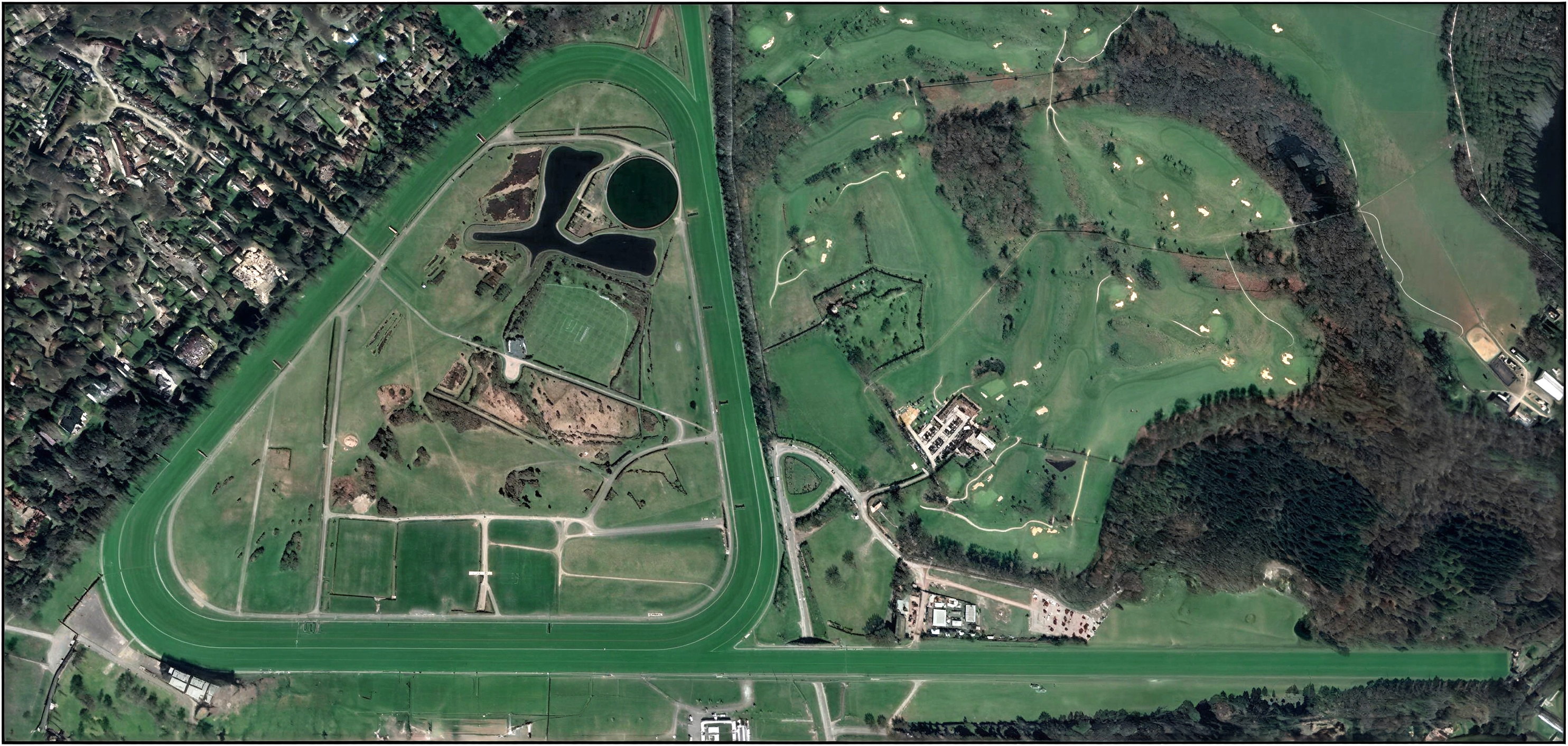
Aerial View – Ascot Racecourse (Image credited to Google Earth)
The straight course starts at the very far end of the track and comes down to the finishing post. It accommodates all races up to one mile, including all five-, six-, and seven-furlong sprint races. Due to having no turns or bends, the draw bias at this track is pronounced, and the statistics clearly show that horses in the low-numbered stalls, those from 1 to 5, have a distinct advantage. In the five-furlong sprints, the track is downhill for the first two furlongs and then a stiff uphill run home in the final two furlongs. In the six-furlong races, the downhill start and uphill finish is even more pronounced, and many horses that look to have the race in the bag are collared in the final half furlong.
The Round Course starts on a chute and is where races over ten furlongs are held. It is right-handed and suits long-striding, galloping-type horses. It has a short run-in of around two and a half furlongs from the final bend to the winning post.
The National Hunt (jumps) course is oval-shaped, right-handed, with no sharp bends or undulations. It has eight fences per circuit, coming in quick succession. The water jump immediately in front of the grandstand is not jumped on the final circuit, so there is a long run home from the final bend to the winning post, which invariably suits hold-up horses who like to come from behind.
In 2004, the racecourse was closed for two years for major redevelopment, including the construction of a new grandstand and the relaying of the racing surface. Since then, the ground in the home straight drains much better than the rest of the course, which means the going on the rest of the course can be soft, while the going on the straight can be much quicker, so going descriptions can vary.
Ascot Racecourse holds around 26 race days a year. Sixteen flat meetings from May to October, 9 National Hunt fixtures from November to April, and British Champions Day in mid-October. Therefore, it is one of the busiest courses in Britain. The track course hosts 13 Group 1 flat races each year, the most of any other British racecourse, and numerous Grade 1 jumps races, which include the Clarence House Chase and the Long Walk Hurdle.
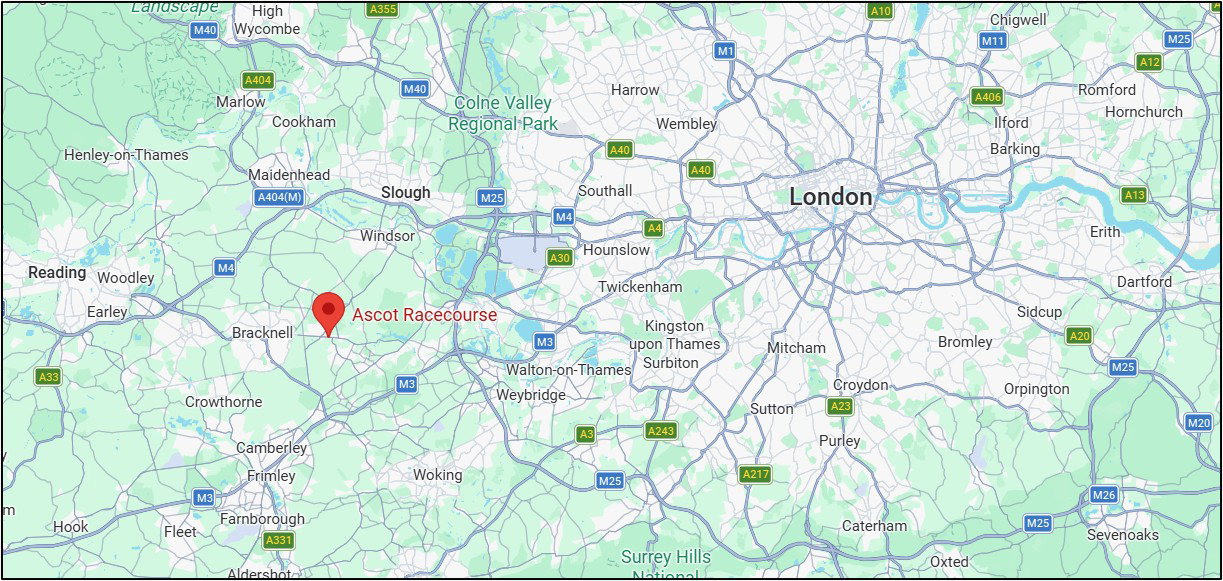
The Racecourse Advisor Guide to Ascot Racecourse: Ascot Racecourse in the affluent commuter town of Ascot in Berkshire, adjacent to Windsor Great Park, which is around 6 miles from Windsor Castle and 25 miles west of London. The racecourse itself covers 179 acres of Berkshire countryside, with the famous Royal Enclosure and grandstands visible from the surrounding area.
Ascot Racecourse is over 300 years old, which makes it one of the oldest racecourses in Britain. It was founded in 1711 by Queen Anne, who decided that a plot of land near Windsor Castle would be ideal for horse racing. The first grandstand was built in 1793. The first running of the Gold Cup at the Royal Meeting was in 1807, when the royal enclosure was established by King George III. The first Ladies' Day meeting was in 1823, and two years later, King George IV initiated the carriage procession down the track before the meeting began. Both traditions continue to this day.
A new grandstand was erected in 1839, and until 1945, the only meeting held at the course was the Royal Meeting, with additional fixtures later added over the years. The Queen Elizabeth II Grandstand was built in 1961 at a cost of £1 million and contains 280 “Private Boxes”. National Hunt (jump) racing was first held at Ascot in 1965. In 2004, the racecourse was closed for two years to undergo a £200 million redevelopment plan. The course was reopened by Her Majesty Queen Elizabeth II in 2006. During the closure, the Royal Meeting was held at York Racecourse.
Course Access: By Road: From London and the M25: Exit the M25 at Junction 13 and follow the A30 towards Bagshot. After approximately three miles, turn left onto the A329 signposted to Ascot. The racecourse entrance is clearly marked on the right as you enter the town centre. Alternatively, exit at Junction 10 and follow the A329(M) and A329 through Bracknell, continuing into Ascot. This route may prove quieter during peak times.
From the M3 and M4: From the M3, exit at Junction 3 onto the A322 towards Bracknell, then follow signs for Ascot on the A329.
From the M4, exit at Junction 6 and take the A355 south through Slough, then the A332 and A329 into Ascot.
By Rail: The nearest station to Ascot Racecourse is Ascot Station, which is a short 7-minute walk to the racecourse entrance. The station is well connected to London, with direct services running from London Waterloo on the South Western Railway line. The journey from London Waterloo takes around 50 minutes. Trains also run from other nearby locations, such as Guildford, Reading, and other towns in the region, directly to Ascot Station
By Air: The nearest airport to Ascot is London Heathrow (LHR), 10 miles away. Other nearby airports include London Gatwick (LGW), 28 miles away. London City Airport (LCY) is 32 miles away, and Luton Airport (LTN) is 34 miles away. Rating: 9/10.
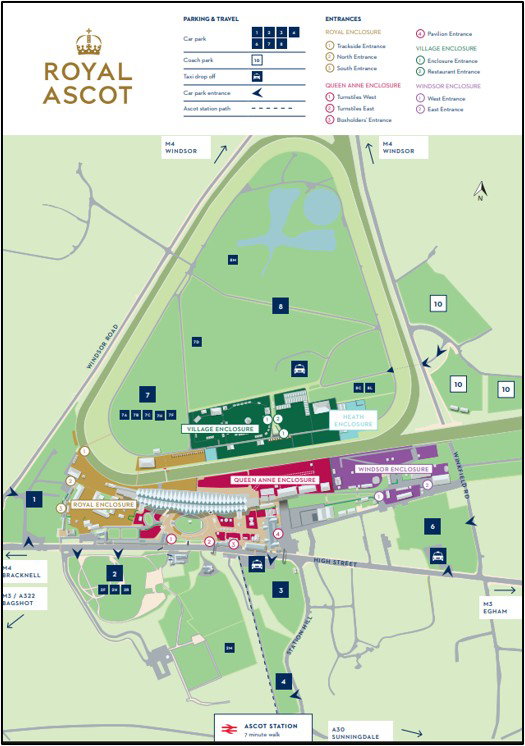
Parking: Car parking is free for every Ascot raceday during both the Flat and Jump seasons (with the exception of the Royal Ascot meeting). Car Park 1 is a large grassy area next to the grandstand, and from there it is around a five-minute walk down High Street to the main entrance. Car Parks 2 and 3 are situated on the other side of the main road leading to the course and are slightly closer. However, these are reserved for jockeys, owners and trainers. Car Park 3 is reserved for Box Holders. Car Park 6 is also open to the public and is located on High Street at the other end of the racecourse. It is also a five-minute walk from there to the main entrance. For the Royal Ascot meeting, car parking must be purchased. It is recommended that you book your car parking in advance to reserve your preferred car park (subject to availability) at a lower price. Car Parking at Royal Ascot is £45 in advance; prices are higher on the day. Rating: 9/10.
Pricing: On the day of our visit, it was the Friday “Racing to Zero Summer Mile, The Property Raceday”, a six-race card that included Four Class 3 races and two Class 4 races, so relatively low-level racing. There were two enclosure options: the Queen Anne Enclosure and the King Edward VII Enclosure. Pricing at the gate on the day was £24.00 and £35.00, respectively. If booked online in advance, the Queen Anne Enclosure was £19.00 or £15.00 for groups of seven or more, and the King Edward VII Enclosure was £30.00. Disappointingly, there are no concessions for OAPs or students. However, children under 18 enter free of charge when accompanied by an adult.
There were several hospitality packages available; however, for some reason, they are not shown on the Ascot racecourse website. You need to complete and submit an online enquiry form to find out the details, which we did. What came back was the “Signature Package”, which is the glass-fronted restaurant located on the fifth floor of the grandstand. For £384 per person, you get a private table, a welcome drink, a three-course meal, a racecard, a car park label and a copy of the Racing Post. You can also add various extras, such as a drinks package for £107 or £150, and a cheeseboard option for a further £18.00.
In our opinion, the pricing above for such a prestigious racecourse is excellent, and entrance into the Queen Anne Enclosure for £19.00 and the King Edward VII Enclosure for £30.00 is a genuine bargain! To put it in perspective, last month we paid £22.00 at the gate to visit Ffos Las, and next month it’s £30.00 at the gate to visit Cartmel Racecourse in the Paddock Enclosure. Hats off to Ascot Racecourse for offering some very seriously good value for money. It really is a refreshing change. Rating 10/10.
Racecard: The racecard had a very high-quality feel, as you would expect from Ascot. The paper stock was noticeably heavier than that used at many other racecourses. It was also slightly squatter than a typical racecard, giving it more of a paperback-book feel in the hand.
There was a detailed introduction from His Majesty’s representative, describing the day’s events and thanking the sponsors. The card also included a contents page showing where all the information could be found.
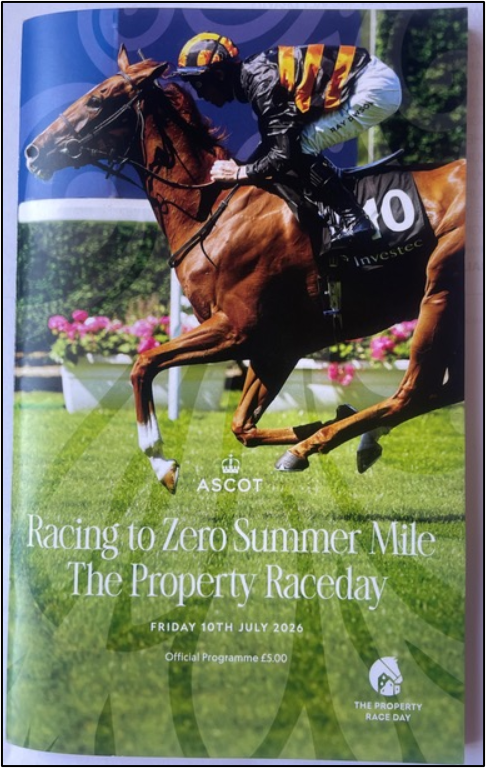
The runners and riders were presented in a clear, easy-to-read format, with comments on each horse provided by Timeform. In addition, the highest-rated horse in each race was highlighted using its Smart View Score from the Racing Post, which was a nice touch.
One area for improvement would be a more detailed map of the grandstands and their facilities. They are truly magnificent, but the existing layout map does not do them justice.
At £5, the racecard was expensive. However, with 64 pages and a high-quality feel throughout, it seemed more like an attractive souvenir than a disposable racecard.
Viewing: The overall viewing experience at Ascot Racecourse is very good. The grandstand, rebuilt and opened in 2006, is truly colossal and easily the largest grandstand at any racecourse in Britain. It really is a sight to behold.
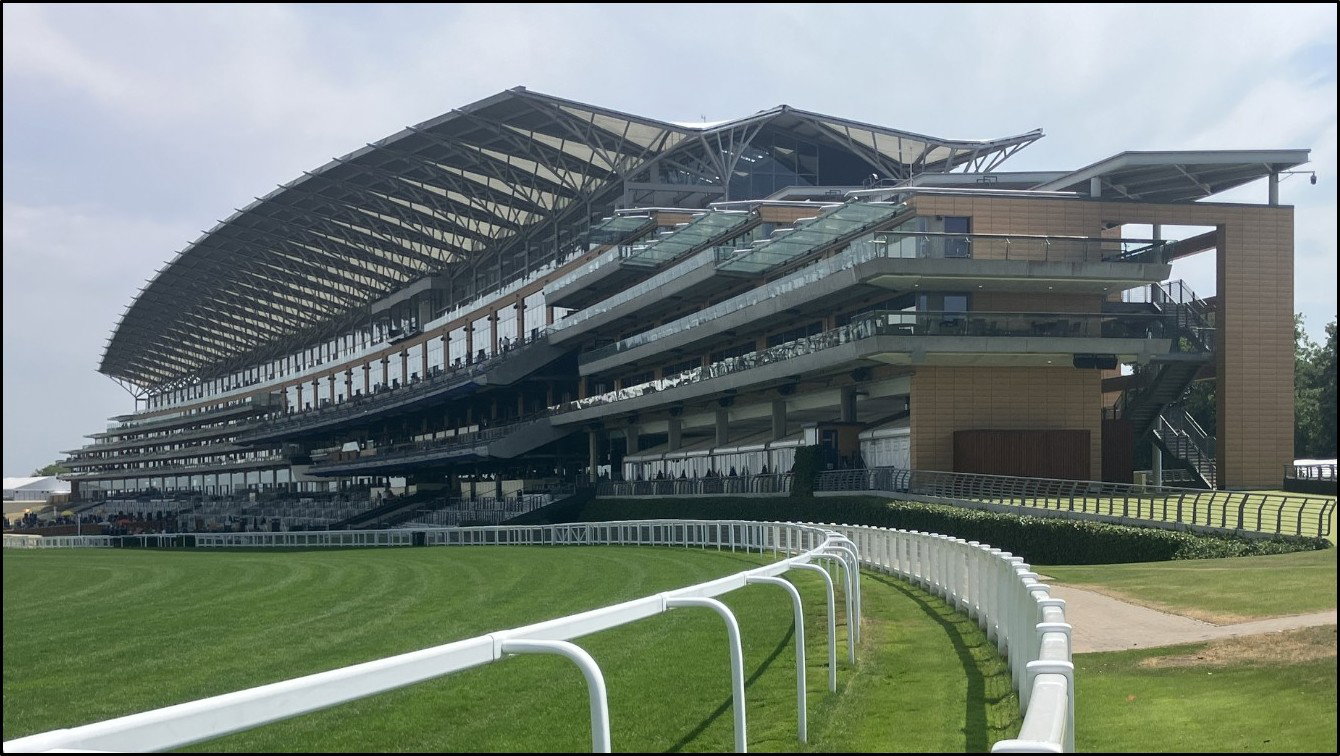
The Grandstand – Ascot Racecourse
The stand spans six levels and can accommodate over 30,000 seated spectators, and the racecourse regularly accommodates over 70,00 racegoers during the Royal Ascot meeting. It is a spectacular structure made of glass and steel that stretches for over 500 yards in length. It features a dual-aspect design, which means you can watch the racing from the front of the grandstand and then walk to the back to view the spectacular Parade Ring on the other side.
On the ground floor is the Grandstand Galleria, a huge 4,000-square-metre space that facilitates the movement of thousands of racegoers, and it's also the home of The Queen Anne Enclosure, which has access to the racetrack, the pre-parade ring, the main Parade Ring, and numerous bars and eateries. Levels 2 and 3 contain hospitality boxes, members' areas and upscale dining locations, including the Parade Ring Restaurant, which is located right next door to the Royal Box. Level 4 is home to the King Henry VII enclosure, which has elevated balconies overlooking both the racecourse and Parade Ring. Level 5 is home to a number of private hospitality boxes, each with its own dining area, dedicated bar, and balconies overlooking the racecourse. It also houses the ON 5 Restaurant, a swish, glass-fronted affair with its own rooftop terrace and views of the final two furlongs of the home straight. Level 6 is home to the highly exclusive Panoramic Restaurant, where Raymond Blanc is the resident chef. It has to be said, the whole place just oozes luxury and class from start to finish.
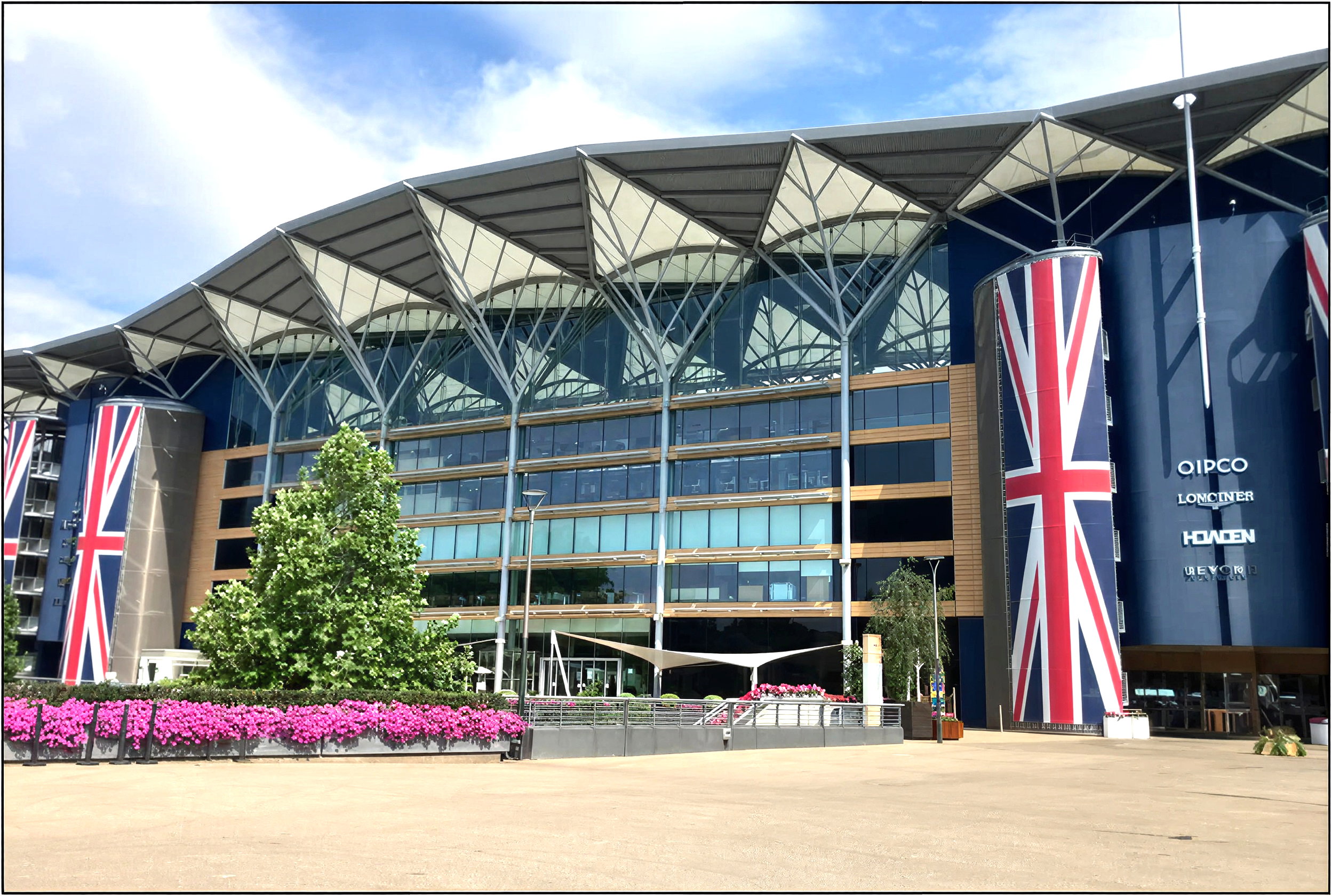
The Grandstand Main Entrance - Ascot Racecourse
The viewing of the racing is also very good. The stand has a huge, cantilevered roof, which ensures the sightlines to the racecourse are unimpeded regardless of where you are standing. The grandstand is so long that it requires three large portable TV screens to cover its full length. Rating: 9/10.
Just outside the main entrance to the Grandstand is a life-size statue of the legendary Frankel
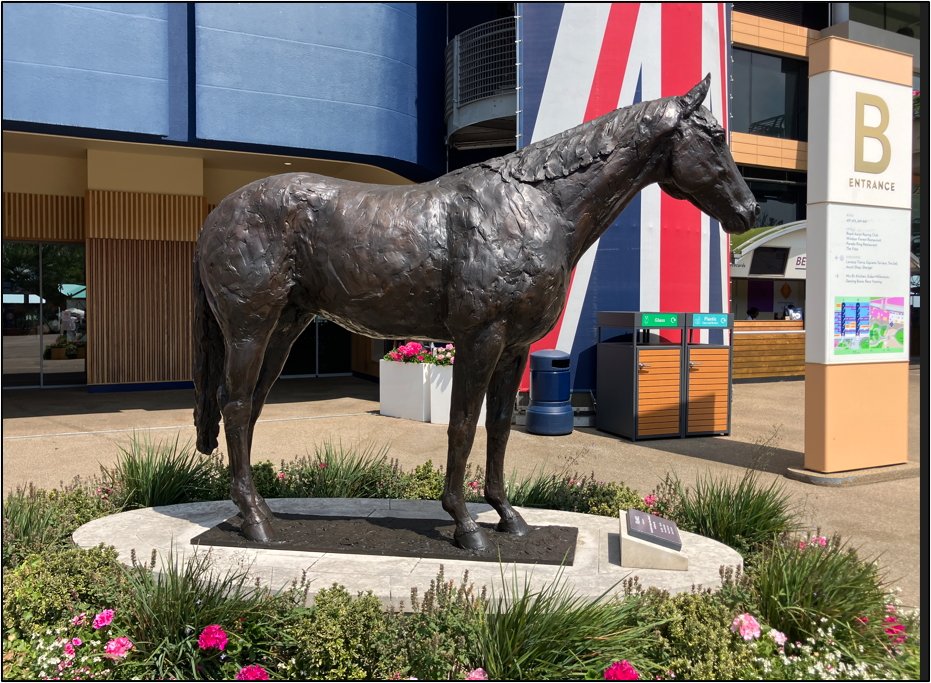
The Frankel Statue - Ascot Racecourse
Parade Ring / Winners Enclosure: Here at Racecourse Advisor, we do like a good Parade Ring, and as you would expect at Ascot, the scale and grandeur of the area is magnificent, and it feels like you are visiting a formal garden in a stately home. It really is the Daddy of them all!
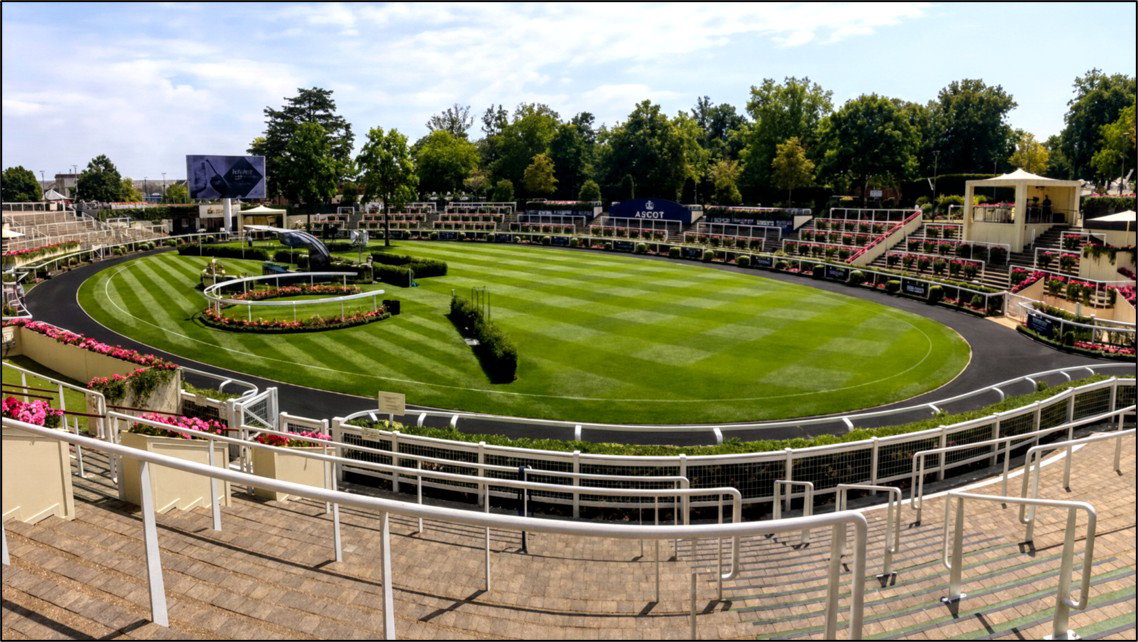
The Parade Ring & Winners Enclosure – Ascot Racecourse
Ascot’s Parade Ring is set in its own amphitheatre below the main concourse level in The Queen Anne Enclosure. It is oval in shape and large. Very large. It is the largest Parade Ring of any racecourse in Britain and can hold around 8,000 people (the Parade Ring at Cheltenham Racecourse can hold around 4,000).
It is the most elegant and photogenic part of the whole racecourse; it is immaculate in every single way. It is beautifully landscaped, with pristine clipped hedges, brightly coloured flower displays and striped lawns that really do look like carpet. It has elevated, terraced viewing steps around its full perimeter, so the viewing experience is the best of the best.
The Winner’s Enclosure is located at the front of the ring, in the centre, and is horseshoe-shaped. It has a gigantic TV screen at the far end. At the back of the area, on the right-hand side, is a small, canopied area used by the TV crews.
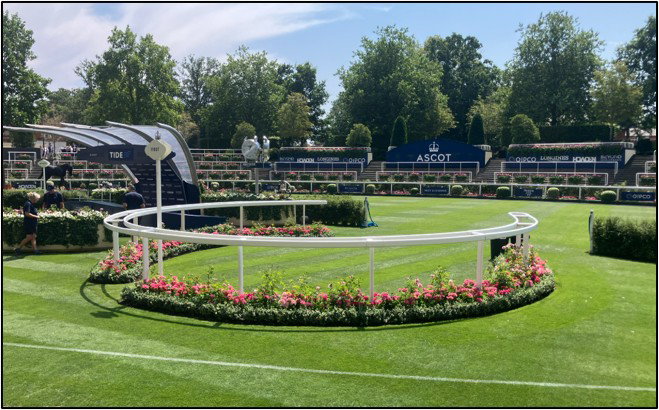
The Winners Enclosure – Ascot Racecourse
The pre-parade ring and saddling enclosure are in a different area altogether. As with everything at Ascot, it is big, grand, and in perfect condition.
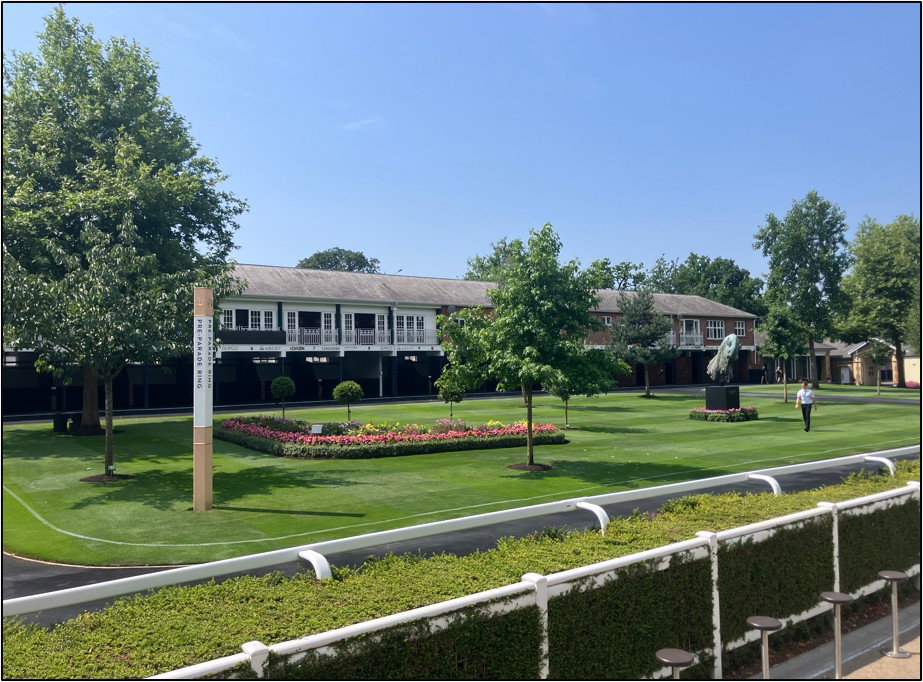
The Pre-Parade Ring & Saddling Enclosure – Ascot Racecourse
It is a lawned area populated with mature trees and colourful flower beds, surrounded by clipped hedges. It has a horse statue in the centre and stools along its perimeter. It’s fair to say that the pre-parade ring here is far superior to the main Parade Ring at the vast majority of racecourses in Britain. If we could mark it higher than a 10, we would. It really is the very best of the best. Rating: 10/10.
Fun Fact: The turfed areas in the Parade Ring are mowed to a precise height of 23mm all year round, with the exception of the Royal Ascot meeting in June, when it is mowed to exactly 19mm to make it look like carpet. No other racecourse review website has this level of insight and can give you this level of detail. This is just one of the reasons why Racecourse Advisor is the UK’s leading racecourse review site.
Bookmakers / Betting Facilities: The on-course bookmakers at Ascot are situated on the Grandstand lawn, directly between the Grandstand building and the course itself. On the day of our visit, there were around 30 bookies plying their trade. There are no Tote concessions on the course, but they do have a “Bet With Ascot” facility, which is a long-term partnership with the Tote, and all bets placed through it go directly into the Tote pool. The Bet With Ascot facilities are literally everywhere on the racecourse.
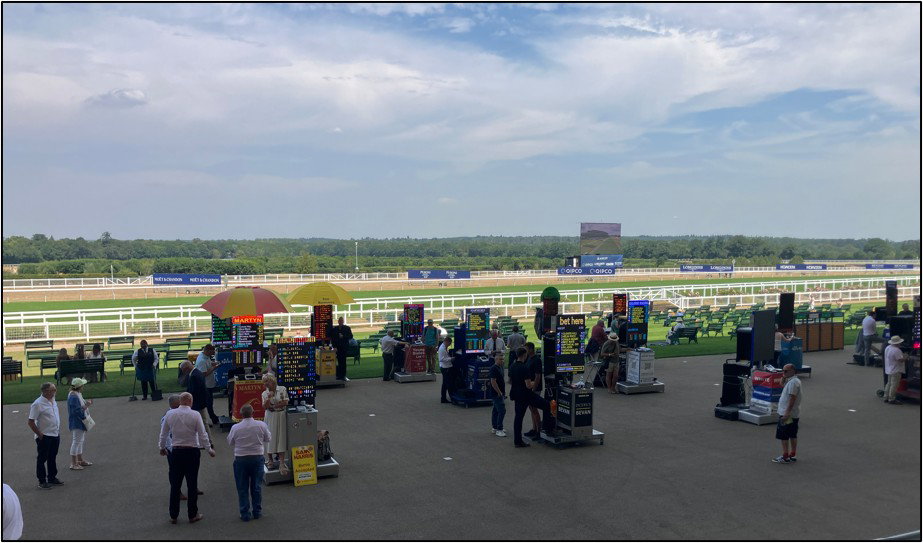
The On-Course Bookmakers - Ascot Racecourse
Betfred is the official bookmaker of Ascot Racecourse and has two betting shops in the Grandstand. It also has numerous Self-Service Betting Terminals (SSBTs) conveniently placed around the Grandstand.
Catering: Here at Racecourse Advisor, we enjoy doing “racecourse reviews” rather than restaurant reviews, and we do not pretend to be food critics. Our aim is to provide you with an overview of the culinary options and prices available at the racecourse on race days. Walking through the main entrance of the grandstand at Ascot is like walking into the lobby of an upscale 5-star hotel. It really does have that feel about it.
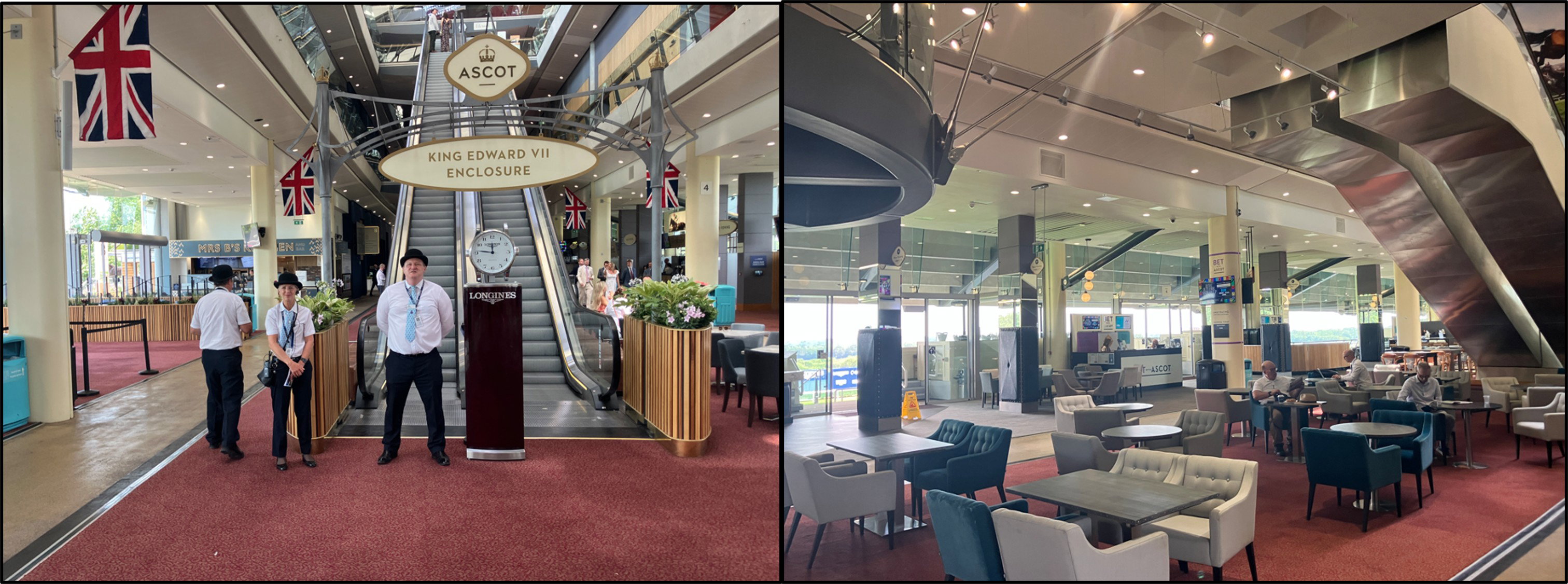
The Grandstand (Ground Floor) - Ascot Racecourse
On the day of our visit to Ascot, the bars were plentiful, but it has to be said that the food and catering options were the exact opposite. All of the bars are named after famous racehorses such as Dubai Millennium, Nijinsky, Choisir, etc.
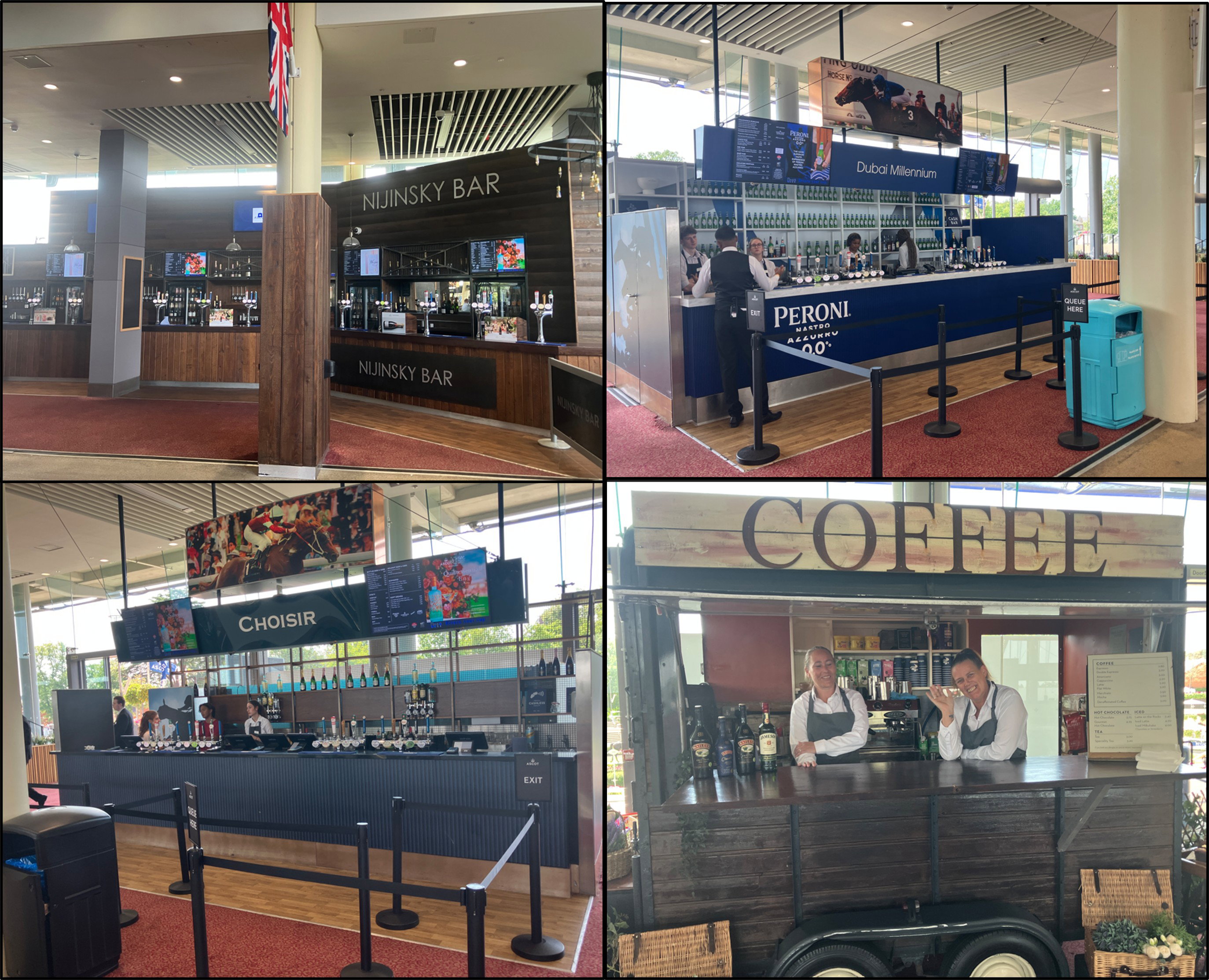
The Bars - Ascot Racecourse
They were selling pints of Grolsch for £7.20, Meantime Prime Pale Ale for £7.80, and Peroni and Guinness were £8.00 a pint. A bottle of Peroni was £5.80. Cornish Orchard Cider £8.10, Asahi Super Dry £7.50, and Guinness Zero was £6.90 a can. Spirits ranged from £6.70 to £7.80 depending on your choice. Wine was £8.00 for a 175ml glass. £11.50 for a 250ml glass, and bottles ranged from £32.00 to £48.00. If you are feeling flush, and a lot of people who frequent Ascot Racecourse are, then bottles of Champagne range in price from £100.00 to £900.00 depending on how discerning your palate is. There is no getting around it: those prices are high. The highest we have ever seen on any racecourse in Britain. The very limited number of catering options included a pizza joint, which was serving freshly made 10” pizzas ranging in price from £14.00 to £16.50 depending on your choice.
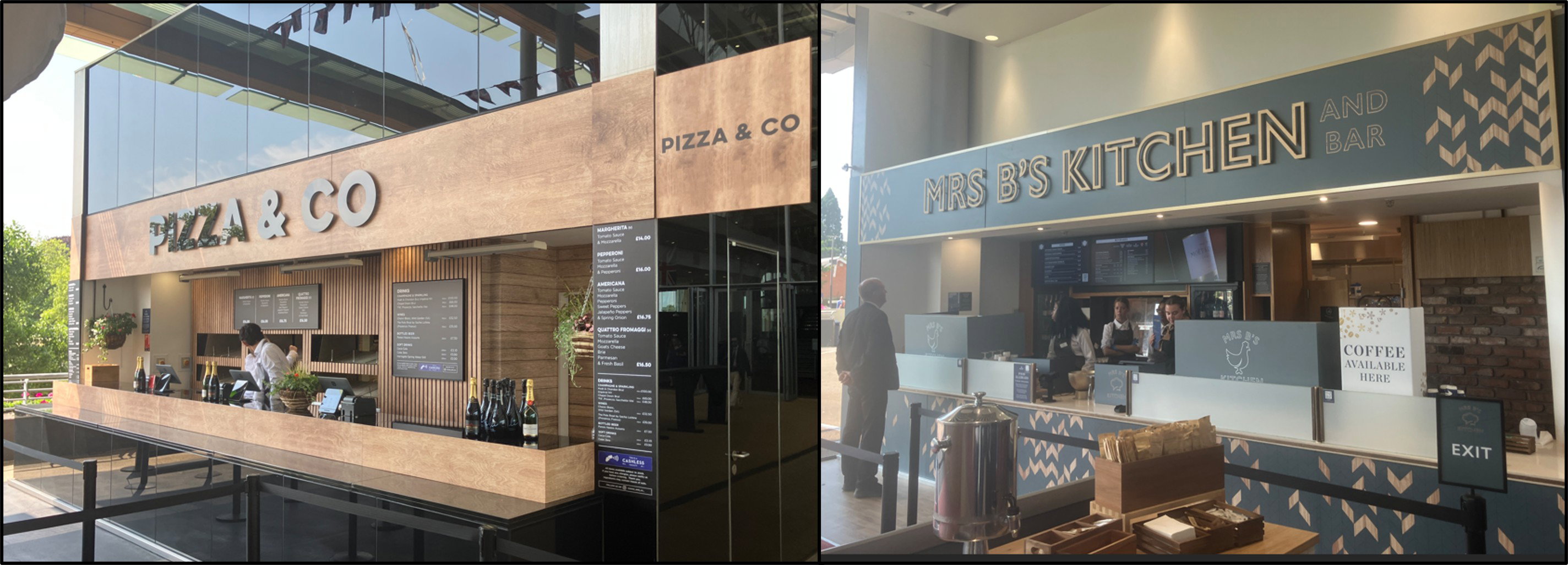
Food Outlets - Ascot Racecourse
We did indulge in an Americano, and to be fair, it was pretty tasty. There was also Mrs B’s Kitchen selling “Reinvented Chicken”, which is basically buttermilk chicken served with waffles and pickles. They had a menu of various chicken tenders and chicken burgers, priced from £12.50 to £16.50 depending on your selection. There was also a small sandwich bar tucked away in one corner selling a range of freshly made sandwiches and drinks. The only other outlet was a coffee stall selling teas, coffees, and hot chocolate priced from £2.80 to £4.00. And on the concourse level of the grandstand, that was your lot. To be fair, there were other food outlets on the second floor, but as we only had tickets for the Queen Anne Enclosure, getting up there was a no-go. We did speak with the staff in the foyer who handle upgrades, and there were very few openings for the restaurants on the higher levels.
So, a good selection of bars, but with prices at the very top of the range and a very limited range of food and catering outlets on the concourse level of the grandstand. Rating: 5/10.
Guinness Standard: Draft Guinness was available at several bars on the racecourse for £8.00 a pint, which is the most expensive of any racecourse we have ever visited, just pipping the £7.99 per pint we paid at Epsom Racecourse the day before. However, it was more than a decent pint of the black stuff, very nicely chilled with a creamy head and served in thick plastic pint pots. Rating: 7/10.
Friendliness of Course Staff: The course staff at Ascot Racecourse were absolutely superb! They all wear bowler hats, so they are instantly recognisable wherever you go on the course. It is fair to say that we have never met a more polite, helpful and knowledgeable set of staff and stewards at any racecourse we have ever visited. To a man and a woman, they are brilliant. Nothing is too much trouble for them. A special shout-out to Alan Graham, who was working in the area where the pre-parade ring and saddling enclosure are located. He spent a good 15 minutes with us telling us about the course, its history and its features. We genuinely appreciated his time. Rating: 10/10.
Pros & Cons: At Ascot Racecourse, the pros are plentiful. The pricing was extremely good value for money. The parking was a doddle. The viewing is superb, and every single part of the racecourse is immaculate in every way, and the pièce de resistance is the Parade Ring, which is a sight to behold. The only con we had was the small selection of food and catering outlets on the concourse level on the day of our visit. Apart from that, everything else is seriously impressive. Rating: 8/10.
As always, here at Racecourse Advisor, we ask ourselves at the end of each review: would we return? The answer is yes; we would, and in the blink of an eye. If you are down in or near the London area and fancy a day out at the races, then we can guarantee you that you will not do better than Ascot Racecourse. Put it on your list and look forward to a treat.
Overall Racecourse Advisor Rating: 8.7/10.
Wi-Fi/Internet Connection: A free, reliable Ascot Wi-Fi connection is available at the racecourse. Select the “Ascot WiFi” network. Follow the on-screen prompts and create an account or sign in.
The entire day's racing results can be found here: https://www.sportinglife.com/racing/meeting/2026-07-10/ascot/120014
Facilities and Location Map of Ascot Racecourse (image credited to Ascot Racecourse
Disclaimer: The reviews contained in this website's content are just the authors' opinions. The views, thoughts, and opinions expressed in the text belong solely to the authors and not necessarily to any other group or individual. Any content or opinions provided in our reviews are not intended to malign any party, group, club, organisation, company, individual, or anyone or anything whatsoever.